
• Skip to primary navigation
  • Skip to main content
  • Skip to primary sidebar

Roadmap Advisors

Roadmap Logo 000033

Middle-Market Strategic M&A Advisory Firm

  • Capabilities

    • Mergers & Acquisitions
      • Sell Side
      • Buy Side
    • Consulting & Advisory
      • Business Exit Strategy
      • Interim CFO
      • Valuation Advisory
      • Value Creation

    Featured insights

    Mergers and Acquisitions Advisors Working On An Business Exit Options For Client

    An Extensive Review Of Business Exit Options

    Explore Business Exit Options with expert guidance. Learn strategies to maximize value, prepare your company for sale, and choose the best path for your future.

    Read More

  • Sector Expertise

    • Facilities Services
      • Landscaping
      • Paving
      • Roofing
      • Access Control
    • Professional Services
      • IT & MSP
      • Marketing Services
    • Industrial Services
      • Maintenance & Repair
      • Infrastructure Services
    • Consumer
      • Food & Beverage
      • Consumer Packaging

    Featured insights

    Roadmap Advisors Landscaping Report Cover

    Landscaping Market Report 2025 Update

    2025 Landscaping Industry Reports & Trending Metrics. Involves developments, new models, and general updates about the sector in 2025.

    Read More

  • Insights
    • Articles
    • Guides
    • Whitepapers
  • About
    • Careers
    • Culture
    • Team
      • Cathy Martinez
      • Chris Novak
      • Jack Burch
      • Jeremy Smith
      • Max Prilutsky
      • Mike Alpert
      • Shonak Bhattacharya
      • Tim Lee
Schedule Consultation

Buy Side M&A

March 30, 2026 by Roadmap Advisors

Buyers Checking Financial Statements of A Paving Company

When paving contractors begin considering a sale, one of the first questions is simple: How will the market value my business? The answer is rarely driven by revenue alone.

Valuations in the paving sector vary widely. While select platform-scale businesses have attracted double-digit EBITDA multiples, most closely held contractors transact at materially lower levels, often below 5x. The difference is not arbitrary. It reflects how buyers assess durability, risk, operational depth, and the predictability of future cash flow.

In This Article: The criteria sophisticated buyers apply when evaluating paving companies, the drivers behind valuation gaps, and the steps that strengthen a contractor’s position ahead of a sale.

What Drives Buyer Interest In Paving Company Acquisitions

M&A for paving companies has expanded quickly as private equity groups, regional contractors, and infrastructure-focused investors seek scalable, essential service providers. 

As the demand for asphalt and pavement maintenance continues to grow, the infrastructure sector’s fragmentation creates opportunities for buyers who want repeatable earnings and a playbook for expansion.  Owners who understand what buyers look for in acquisitions can position themselves thoughtfully and limit surprises during due diligence. 

Roadmap Advisors has seen this dynamic across both buy-side and sell-side assignments, and our experience shows how important it is for companies to articulate their operating model clearly. 

Financial Performance and Profitability Trends

Steady performance is often at the center of a paving company’s valuation. Buyers evaluate how the revenue by customer tracks from year to year, through economic cycles and across weather-related seasonality. 

The mix between municipal contracts, private commercial work, and recurring maintenance services can sometimes influence how durable earnings are perceived to be.

Margin analysis typically includes a close examination of job costing, equipment utilization, and the age and maintenance profile of the fleet. Given the capital-intensive nature of paving equipment, future capital expenditure requirements are a meaningful consideration.

Backlog visibility can materially affect valuation, so companies that are awarded municipal contracts, have multi-year service agreements, or are scheduled for work in advance typically present forward-looking projections based on backlog. 

A combination of clean financial reporting and clearly supported EBITDA adjustments, including treatment of owner-operated assets or related-party arrangements, help buyers assess true cash flow and compare opportunities within the sector.

Operational Strength and Scalability

Road Paving Operations with Heavy Equipment and Workers

Road paving companies with organized operations often stand out because buyers want businesses that can support growth without major structural changes. 

A leadership team that can bid, schedule, and manage crews with limited owner involvement carries obvious appeal. Scheduling software, GPS tracking, and integrated cost-control tools demonstrate discipline in the field, giving buyers confidence that the company can scale as demand increases.

Repeatable processes, documented training, and formal safety programs make the business easier to transfer to new ownership. Buyers assess whether systems can accommodate additional crews, new service offerings, or new branch locations with a manageable investment. 

Prospective buyers have an eye on the future of the business. Evidence of scalability tends to support stronger interest in a sale since the buyer sees an opportunity to grow the platform after closing.

Customer Concentration and Contract Quality

Revenue stability is one of the first areas buyers evaluate. When a company relies too heavily on just a few customers, it increases perceived risk, and that risk frequently results in lower purchase offers.

  • A diversified base of commercial clients, municipalities, and property managers usually feels more resilient to an acquirer. 
  • Multi-year agreements, ongoing maintenance programs, IDIQ contracts, and long-standing relationships with large clients create confidence during acquisition due diligence.

Owners preparing for a sale may benefit from assembling a three-year customer analysis that outlines revenue trends, renewal patterns, and contract structure. It provides buyers with a clear view of customer stickiness, helping to alleviate concerns about revenue volatility. 

Equipment, Assets, and Fleet Management

A paving contractor’s fleet represents a substantial portion of enterprise value. Well-maintained pavers, rollers, trucks, and related support equipment signal reliability in the field and lower the probability of unplanned capital spending after a sale. 

Buyers will review fleet age, utilization data, and replacement cycles to understand future cash needs.

Since paving tends to be a capital-intensive business, buyers scrutinize EBITDA minus capital expenditures (CapEx) to assess the true cash flow. Owned equipment generates depreciation and requires periodic replacement, while leased equipment creates an operating expense on the P&L. 

These differences influence the EBITDA multiple buyers are willing to apply, so sellers who present an intentional history of capital expenditures and fleet strategy tend to move through diligence with less friction.

Market Position and Reputation

A strong regional presence can meaningfully influence the interest of an acquirer. Contractors known for quality work, dependable schedules, and consistent communication often develop long-term client relationships that survive economic swings. Other features to highlight are:

  • A solid safety record and disciplined environmental practices provide buyers with added confidence. 
  • Digital presence and online reviews are more visible to acquirers than many owners expect, and testimonials or case studies help validate the company’s reputation.
  • Cultural alignment also matters because a positive reputation makes it easier for the buyer to retain employees and maintain customer relationships after closing.

Preparing for the Sale Process

Owner Preparing to Sell His Paving Business with an Advisor

Owners who begin early and organize their materials experience fewer delays during diligence. Clean financial statements, reconciled WIP schedules, documented processes, and organized contract files all help buyers review the information more efficiently. 

Many owners also choose to engage advisors who specialize in business readiness for sale since a knowledgeable partner can help refine the narrative, address gaps, and position the business for a competitive process.

Roadmap Advisors works with owners at every stage, whether they are considering a sale now or planning several years in advance. Our support helps business owners frame the company’s strengths, anticipate buyer questions, and negotiate thoughtfully with qualified acquirers.

Aligning With Buyer Priorities for a Better Outcome

Sellers who understand buyer expectations typically experience a more efficient and rewarding process.

Having clear financials, organized operations, a diversified customer base, and a strong reputation helps buyers develop confidence in the future of the business and often leads to stronger offers. Preparation strengthens transparency, and transparent companies tend to attract more committed acquirers.

Roadmap Advisors guides paving business owners through every stage of a potential sale. From preparing the business and identifying value drivers, to managing buyer interactions, overseeing diligence, and structuring the transaction, we ensure owners remain in control and informed throughout the process. 

Our support continues beyond closing, helping with integration, knowledge transfer, and operational continuity to protect the business you built and your long-term objectives. Confidential conversations with our team provide a roadmap for timing, strategy, and next steps tailored to your goals. 

Filed Under: Buy Side M&A, Mergers & Acquisitions

March 23, 2026 by Roadmap Advisors

Buyers Reviewing Customer Concentration Risk Management Strategy in M&A

Customer concentration is one of the most scrutinized risks in any M&A process. When a meaningful share of revenue is tied to a handful of accounts, buyers look closely at the stability, longevity, and transferability of those relationships. High concentration doesn’t automatically reduce value, but it does change the way buyers underwrite risk and structure a deal.

Owners preparing for a transaction benefit from understanding how concentration influences buyer psychology, what drives valuation adjustments, and which steps meaningfully reduce exposure before due diligence begins. Preparation, often months before going to market, separates sellers who defend their valuation from those who concede ground at the negotiating table.

In This Article: You’ll learn how buyers evaluate the customer concentration risk of a company during an acquisition, the factors that shape their interest and pricing, and the practical steps owners can take to strengthen readiness for a future transition.

Why Customer Concentration Matters In M&A Transactions

Customer concentration refers to the share of total revenue generated by the top accounts. Buyers look at the percentage tied to the largest customer and the cumulative contribution of the top five or ten. 

Training materials often signal that a single customer, representing over 20% of revenue, can raise questions about durability of the account. These patterns influence how buyers think about future cash flow stability and the probability of realizing projections.

Reliance on a few accounts often decreases business valuation, as a lost client can significantly impact financial performance. Buyers adjust valuation multiples downward when they believe revenue streams lack diversification or carry material renewal risk. 

Structured preparation with advisors helps owners anticipate these concerns and develop data that gives buyers a clearer view of stability.

How Buyers Evaluate Customer Concentration Risk

Buyers examine revenue by individual client, industry segment, geography, and contract type to understand dependency patterns. They request multi-year schedules showing revenue, gross margin, and the nature of each relationship. 

Concentration levels that exceed common thresholds, such as one customer generating more than 20% or the top ten reaching 70%, often trigger deeper diligence.

Recurring revenue can soften perceived risk. Multi-year agreements and auto-renew contracts with established renewal histories provide reassurance that revenue is less fragile than surface percentages suggest. 

Clients with a  history of repeat purchases, even if not by way of a contractual obligation, further reduce concerns about churn because their consistent buying behavior signals strong satisfaction with the service, high switching costs and/or a lack of substitutes.

The Impact On Valuation And Deal Terms

Group of Professional Buyers Calculating Business Valuation Using Financial Charts

High concentration frequently influences valuation multiples because buyers model downside scenarios that assume partial or full churn of a large account. These adjustments reduce implied value and narrow the pool of potential acquirers, particularly in situations where lenders hesitate to finance a heavily concentrated business.

Some buyers decline to proceed when concentration exceeds internal limits. Others continue, but seek protection through deal structures. Holdbacks, escrows, or seller notes allow buyers to share uncertainty with sellers while still advancing toward closing. 

Clear, early communication from the seller helps project confidence in the numbers, since transparency signals an understanding of the underlying revenue quality.

Strategies To Mitigate Customer Concentration Before a Sale

Owners gain the strongest advantage when they begin planning years in advance of going to market. An M&A strategist can guide concentrated efforts in:

  • Development of a customer diversification strategy through targeted new logo acquisition or entry into adjacent verticals can reduce headline exposure. 
  • Expansion into segments that resemble the company’s current strongholds provides a practical path toward rebalancing the revenue mix.
  • Cross-selling into additional departments, locations, or business units of existing clients spreads revenue across multiple stakeholders, thereby lowering the perceived fragility. 
  • Strengthening recurring revenue through subscription models or multi-year agreements adds predictability that buyers value. 
  • Maintaining clear records of relationships, a straightforward process for renewals, and organized CRM data demonstrates that important knowledge is retained and can be shared, which helps build trust.

Addressing Concentration During The Deal Process

Concentration can be reframed as a form of stability when the major client is an anchor account with long tenure, high switching costs, or operational reliance on your product or service. 

Buyers want to understand how the relationship functions within the customer’s organization. A dependency on a single executive raises concerns, while a network of sponsors, day-to-day contacts, and procurement teams suggests durability.

Certain situations may warrant carefully coordinated communication with major clients. Under strict confidentiality, a conversation can lead to supportive statements or renewed commitments that reduce buyer uncertainty. 

Retention metrics, satisfaction scores, and tenure data should be included in the data room, allowing buyers to evaluate actual performance rather than relying on assumptions. Rely on experienced advisors to help shape this narrative in a balanced, fact-based way.

Negotiation Tactics To Protect Value

Buyer Negotiating with Business Owners to Protect Value

Contingent payments give buyers protection while preserving upside for sellers. Earnouts tied to total revenue or gross profit prevent scenarios where the entire payout depends on a single account. 

If a major customer is lost but the business replaces the revenue with new clients, earnout mechanics based on overall performance still provide a path to earn the contingent consideration.

Sellers can negotiate partial upfront payment while offering measurable retention targets or performance bands for the remaining value. In any scenario, definitions matter: clear agreement on what counts as retention, how revenue is attributed, and how performance is measured prevents disputes. 

Scenario modeling from an M&A advisory firm helps owners understand the financial trade-offs and prepares them for negotiations with potential buyers.

Position Your Business For Stronger Negotiations And Higher Buyer Confidence

Customer concentration risk becomes more manageable when owners prepare early, document relationships clearly, and present context around the strength of their largest accounts. 

A thoughtful process can shift buyer mindset from fear of volatility to recognition of stable and embedded relationships. Structured planning with advisors provides sellers with the data, framing, and deal strategies necessary for stronger positions in M&A negotiations.

Owners interested in improving their readiness for a future transaction can connect with Roadmap Advisors to discuss preparation steps that support stronger outcomes.

Filed Under: Buy Side M&A

February 27, 2026 by Roadmap Advisors

Male M&A Buyer Reviewing Financial Documents

When a company goes to market, most owners focus on highlighting strengths, such as growth, loyal customers, and long-term potential. Buyers get excited by the story. They’re looking for reasons to say yes. However, during due diligence and evaluation of the opportunity, experienced buyers start looking for red flags. Unfortunately, unprepared business owners don’t think far enough ahead and lack the ability to think like a buyer and objectively evaluate their readiness.

In practicality, the marketing materials for a business sale create momentum. The first call often goes really well. In relatively short order, buyers start asking more detailed questions and narrow in on the areas of potential weakness. 

Understanding what draws a buyer’s attention first and preparing accordingly can make the difference between a strong exit and a prolonged negotiation to the bottom or even a dead deal. This article explains common value challenges in M&A and outlines how sellers can prepare to present their business effectively.

What You’ll Learn in This Blog

  • How Buyers Spot Risk Early
  • Common Value Killers in M&A
  • Protecting Your Deal Value
  • Strengthening Leadership and Operations
  • Partnering with Experienced Advisors

The First Impression

Buyers evaluating a potential acquisition want to like the deal.  In fact, their primary role is often identifying opportunities to invest in great businesses.  It is human nature to feel optimistic when an opportunity is presented.  Company sellers often lead with the positives, as they are most bullish on the business that they run. As a result, the norm is a positive portrayal of the business for sale, met with a positive first impression by the prospective buyer.

However, not every first impression goes this way.  If the seller evades questions, or isn’t prepared to address flaws, it introduces a heightened sense of apprehension in the buyer. No business is perfect, and buyers don’t expect perfection. But, there’s an art to creating a first impression that leaves both sides feeling a sense of trust and heightened interest in pursuing a deal together.  

Sellers who anticipate potential concerns and address them proactively demonstrate credibility, preparedness, and transparency. These qualities increase buyer confidence and make negotiations smoother once valuation discussions begin.

Key Signals Buyers Notice Early

Buyer Side Advisor Highlighting Key Signals in Sales Report
  • Financial organization: Accurate, consistent, and complete reporting shows control and transparency.
  • Operational stability: Well-documented processes and clear responsibilities indicate the business can function smoothly after the transition.
  • Customer and revenue reliability: Stable, diversified customer relationships that are managed proactively signal sustainability.
  • Leadership strength: A cohesive management team signals continuity beyond the founder or key individual.

By understanding what buyers notice first, sellers can focus on the areas that most influence early perceptions, helping protect deal value and accelerate progress through due diligence.

Value Killers That Can Impact a Transaction

Buyers are trained to spot early warning signs that indicate hidden risk. Even minor issues can shape how they perceive a company’s stability and earning power.  Addressing these concerns ahead of time helps protect value and maintain confidence.

Value KillerWhat Buyers NoticeHow Sellers Can Mitigate
Sloppy or Inconsistent FinancialsIncomplete records, unclear revenue recognition, or gaps between statements and normalized EBITDA create uncertainty and may reduce offers.Clean up reporting, reconcile accounts, and prepare clear financial statements. Transparency signals control and reduces diligence timelines.
Customer Concentration RisksHeavy reliance on one or two major customers increases perceived vulnerability. Buyers question what happens if a key account leaves.Demonstrate efforts to diversify the customer base, highlight new client wins, maintain a steady pipeline, and expand into adjacent markets.
Over Reliance on the Founder or Essential PersonIf a single individual drives growth, makes critical operational decisions, or manages key relationships, buyers see continuity risk.Document workflows, develop a capable management team, and ensure other employees are involved in customer and operational responsibilities. Evidence of stability beyond the founder builds buyer confidence.

Getting Ahead of the Risks

Most value killers can be managed when identified early. The challenge is seeing them objectively, from the point of view of a buyer. When it comes to their own business, many sellers fall into the trap of wearing rose colored glasses. Conversely, some of the most successful exits come from CEOs who are self-critical about their businesses. They know their flaws, and they address them head-on. This demonstrates the seller’s readiness, professionalism, and control, all of which are qualities that build buyer confidence and reduce the chance of unexpected setbacks later in the deal process. 

Proactive Steps to Reduce Deal Risk

  1. Clean and organize financials
    • Align financial reporting in a way that reflects the core drivers of your business, and report on financials in a consistent manner.
    • Standardize your month- and year-end close process with checklists, aiming for a rapid close that produces regular financials and KPI reports
  2. Diversify customer base
    • Highlight efforts to reduce dependency on a few major accounts.
    • Demonstrate quantified sales pipelines, new client win rates, and an attractive return on sales & marketing spend
  3. Strengthen leadership and management
    • Build a capable management team that can operate independently of the founder.
    • Document workflows and ensure other employees participate in key operations and customer relationships.
  4. Document operations and systems
    • Ensure processes are clearly outlined and easily transferable.
    • Upgrade outdated technology or infrastructure to reduce operational risk during transition.
  5. Engage experienced advisory support
    • Partner with M&A advisors who can identify hidden risks and help position the business effectively.
    • Advisors add credibility and help transform preparation into negotiation leverage.
M&A Advisor Showing Value Killers for Buyers in Documents

By systematically addressing these areas, sellers can shorten diligence timelines, reduce the chance of re-trade, and strengthen buyer confidence, all of which support a smoother and more successful transaction.

Protect Your Business Value with a Trusted Partner

Selling a business can be multi-faceted and personal. At Roadmap Advisors, we combine deep M&A expertise with a hands-on, empathetic approach to guide owners through every step of the process.

Take Action Today  Schedule a confidential consultation to:

  • Identify potential risks before buyers do
  • Strengthen operations and leadership continuity
  • Present your business with confidence to maximize value

By preparing early with a trusted advisor, you can reduce uncertainty, protect deal value, and move through the sale process with clarity and control. 

Filed Under: Buy Side M&A, Mergers & Acquisitions

February 2, 2026 by Roadmap Advisors

Financial Buyers Making Strategy to Maximize Business Sale

In mergers and acquisitions, buyers generally fall into two categories: strategic or financial. Both may have the capital and interest to acquire your company, yet their motivations, deal structures, and post-acquisition intentions are distinct.

When owners understand these distinctions, they can plan their exit strategy more clearly and make informed decisions throughout the sale. It shapes how you position your company in the market, the types of buyers you attract, and the future you create for yourself and your business. Advisors and M&A professionals consistently emphasize that recognizing these buyer types early can shape the success of a transaction.

A well-prepared Confidential Information Memorandum (CIM) should reflect these distinctions, presenting your company in a way that appeals to the buyer type most aligned with your goals. This article outlines the key distinctions between strategic and financial buyers and what they mean for business owners planning a sale.

Choosing Between Strategic and Financial Buyers

Financial and strategic buyers have unique motivations when looking to buy a business. Understanding the goals of these buyers helps you understand how valuable your company may appear to each.

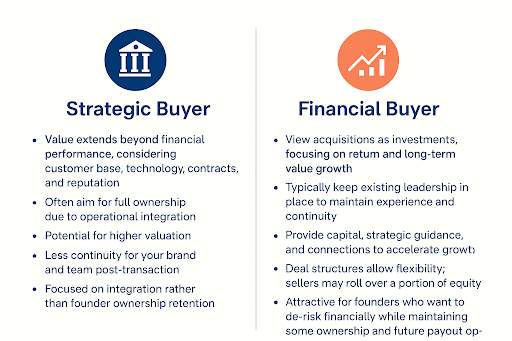
Strategic buyers are looking to buy your company to strengthen their own, and they do this by considering factors like your customer base, contracts, and reputation. They seek integration, and while their plans may increase valuation and result in high offers, the brand and team may be lost in the process.

This may result in some initial growing pains, but the end result is typically worth those costs. Strategic buyers are potentially not a good fit for business owners who want their company to operate independently post-transaction. 

Financial buyers, on the other hand, may not make many changes to a company’s structure right away. Instead, they’ll focus on changing strategies to cut costs and boost revenue. While they may see the investment as long-term, many also pay attention to any available exit strategies.

They may not have the same experience with the industry as a strategic buyer, and may expect the sellers to stay involved for a period of time as an operator or consultant.

Strategic vs Financial Buyer Differences
Key Takeaway: Strategic buyers integrate to grow their business and may drive higher valuations, while financial buyers optimize performance and focus on returns. Knowing these motivations helps position your company for the best outcome.

Strategic or Financial: Choosing the Right Buyer to Match Your Exit Goals

The value of selling a business goes beyond the number on the check. A truly successful sale aligns with your personal and professional goals. The type of buyer you choose can influence your post-sale experience, your ongoing involvement, and the legacy you leave behind.

Buyer   TypeIdeal Seller GoalKey AdvantagesConsiderations
Strategic BuyerFull exit, retirement, clean transitionPremium offers, operational synergies, simpler exitNo post-sale control; decisions shift entirely
Financial BuyerContinued involvement, growth focusAccess to capital, professional support, shared upsideLonger timeline for full liquidity; requires active participation

Strategic Buyer: Ideal for sellers seeking a full exit or retirement. Strategic buyers often pay a premium because of potential synergies with their existing operations. This route usually results in a cleaner transition, but once the deal closes, decision-making and control shift entirely to the new owner.

Financial Buyer: Best for sellers who want to remain involved in the company’s growth. Financial buyers bring capital and operational expertise to support expansion, acquisitions, or professionalization initiatives. It is common for financial buyers to require sellers to hold onto a portion of the company post-transaction, which allows you to benefit from the upside of the business’s next chapter.

Why Making the Distinction Early Matters

M & A Advisor Consulting with Business Owner to Make A Decision

An experienced M&A advisor will help you evaluate how each type of buyer views your business, what value drivers matter most to each of them, and how to position your company accordingly. Well-run processes consider both perspectives, but customize positioning and deal structure to attract the most fitting counterparties.

Buyer categories matter, but are secondary to structuring a deal that reflects your priorities during the transaction and after it’s complete.

Choosing the Right Partner for Your Next Chapter

When sellers structure deals around buyer motivations, both sides benefit, resulting in smoother and more successful transactions. With thoughtful preparation, the right partner can achieve both liquidity and lasting success. At Roadmap Advisors, we help business owners make these decisions with confidence. Our team brings experience from both the buy-side and sell-side, so we understand what drives value from every perspective.

Our process starts with getting to know your goals and vision so we can help shape an exit plan that meets your definition of success. If you’re thinking about selling or preparing for a future transaction, schedule a confidential consultation with our advisors. Together, we can identify the right buyers, structure the right deal, and create an outcome that reflects the full worth of what you have built.

Filed Under: Buy Side M&A, Mergers & Acquisitions

November 10, 2025 by Roadmap Advisors

In acquisitions, integration risk refers to the potential challenges that arise when two organizations are combined. Key issues include aligning systems and operations, merging company cultures, retaining essential talent, and maintaining customer relationships.

Integration risk matters because the success of an acquisition often depends on whether the combined company can operate effectively and achieve the expected synergies. A transaction that looks strong on paper can quickly lose momentum if the integration phase isn’t managed with care and precision.

Different types of acquirers evaluate this risk in distinct ways. The motivations and experiences of strategic buyers, private equity investors, and search fund entrepreneurs differ, resulting in contrasting approaches to valuation and integration. Knowing these differences helps business owners anticipate how potential buyers will view their company.

The Strategic Buyer’s Lens

Strategic buyers are typically established operating companies seeking to strengthen their market position by acquiring complementary or synergistic businesses. Most importantly, they are already in the business. This means that they have existing and entrenched views on the right CRM/ERP system to use, the appropriate compensation model for the sales team, the branding & messaging with customers, the way to approach recruiting, and a number of other key decisions that you have separately made and may or may not align on.

Unlike purely financial buyers, they pursue acquisitions to capture synergies, expand market presence, and add capabilities or technologies that accelerate growth.

Because their value creation depends on combining operations successfully, strategic buyers pay close attention to integration risk. Their primary concerns include:

  • Culture Clash Between Companies: Differences in leadership style, communication, and values can create friction. Strategic buyers analyze how teams make decisions and interact to gauge compatibility.
  • Operational and Systems Alignment: The ability to merge processes, technology platforms, and reporting systems influences how quickly value can be realized.
  • Technology and Cybersecurity Risk: Technology and cybersecurity have become critical components of integration planning. Buyers now evaluate how securely systems can be merged, how data will be protected during the transition, and whether the target’s IT infrastructure meets modern security and compliance standards.
  • Retention of Primary Talent and Customers: Maintaining relationships with core employees and customers helps preserve revenue and institutional knowledge through the transition.

How Strategic Buyers Manage Integration Risk

Strategic buyers begin managing integration risk long before a deal closes. For them, due diligence has two goals:

  1. To determine whether to move forward with the deal
  2. To create a plan for integrating the companies in a way that maximizes their risk-adjusted returns

They take into account external environmental factors: competition, market changes during integration, supply chain issues, macroeconomic shifts that can affect integration more than expected. Using pre-closing due diligence, they examine how well the target’s operations, culture, and leadership align with their own organization, and plan for day-one alignment across leadership, technology, and communications to establish a clear direction immediately after closing. 

To manage the transition effectively, many organizations develop formal integration playbooks that detail actions, deadlines, and accountable parties. Implementation is typically driven by cross-functional teams, with representatives from finance, operations, HR, and IT collaborating to execute the plan.

The pace of integration is another consideration. Moving too quickly can disrupt operations, while excessive caution can delay synergy capture. Strategic buyers work to strike a balance, maintaining stability while progressing toward full integration. 

Comparison: Other Buyer Types

Not all acquirers approach integration the same way: private equity groups, independent sponsors, and search fund buyers assess risk based on their resources, experience, and goals. Comparing their perspectives with those of strategic buyers reveals how preparation and positioning can influence perceived deal value.

Private Equity Firms

Private Equity Firms Investing Representation

Private equity firms often approach integration with financial discipline and proven frameworks. They typically rely on experienced operating partners who specialize in post-acquisition execution. 

Their playbooks focus on efficiency, cost management, and growth initiatives. For these buyers, integration risk is viewed as manageable through planning, oversight, and accountability.

Note: Although PE firms may use standardized integration playbooks and operating partners, they may also may bring in outside specialists. The degree of hands-on involvement depends on the firm’s strategy and the size and complexity of the target.

Independent Sponsors and Search Fund Buyers 

Unfunded buyers may have less direct experience with integration challenges. They depend heavily on the existing management team, external advisors, and investors for guidance. 

Without a well-developed framework, they may underestimate issues related to culture, leadership continuity, or customer retention that strategic buyers tend to anticipate.

Note: While search fund buyers sometimes have less experience in integration, many are supported by investors and advisors, and so levels of preparedness can vary widely. 

Lessons for Sellers

Knowing how different buyers view integration risk helps sellers position their companies more effectively. Strategic buyers often place the greatest emphasis on alignment, since their ability to realize synergies depends on it.

Sellers can make their businesses more attractive by anticipating integration concerns:

  • Building a strong, stable management team that can guide the business through a transition
  • Maintaining organized, transparent financial systems and processes
  • Documenting operations and systems to make integration planning easier
  • Defining and communicating a clear company culture
  • Demonstrating strong employee engagement and customer loyalty

These steps help reduce perceived risk and show buyers that the company is ready for a smooth transition.

How Anticipating Integration Issues Increases Deal Appeal

A company that proactively addresses integration challenges signals to buyers that it can align quickly and effectively. Buyers value businesses that are disciplined, transparent, and adaptable. 

Pro Insight: Seasoned M&A advisors recommend showcasing operational discipline and leadership unity early in the process. When buyers see a management team aligned around clear systems and shared goals, they’re far more likely to view the business as low-risk and ready to realize its full value post-acquisition.

Positioning Your Company To Reduce Perceived Integration Risk

Representation of Successful Business Integration to Reduce Risk

Preparation pays off when entering discussions with potential acquirers. Sellers who can clearly describe how their company would integrate into a larger organization gain an advantage in negotiations. 

Pro Insight: Before going to market, document how your business operates and ensure systems and reporting are clean and current. Top advisors know that buyers place a premium on companies with transparent processes and modern infrastructure because it reduces uncertainty and accelerates integration planning.

Preparing For Integration Success With Roadmap Advisors

Integration risk often determines whether an acquisition achieves its intended outcomes. For strategic buyers, whose success depends on achieving synergy and alignment, managing this risk is central to their approach. Sellers who understand these dynamics and prepare thoughtfully can build confidence, strengthen negotiations, and increase their appeal to the right buyer.

At Roadmap Advisors, we help business owners position their companies for successful transactions by viewing the process through the eyes of strategic buyers. Our advisors combine hands-on M&A experience with deep empathy for the challenges owners are presented with during the transition.

If you’re considering a sale and want to understand how to reduce perceived integration risk, strengthen buyer confidence, and prepare for a smooth transaction, we invite you to schedule a confidential consultation with our team. 

Filed Under: Buy Side M&A

Primary Sidebar

Roadmap Advisors logo white

8065 Leesburg Pike, Suite 507
Tysons, VA 22182

Link to company LinkedIn page

Link to company X page

Max Prilutsky, Jeremy Smith and Jack Burch are Registered Representatives of the broker dealer StillPoint Capital, LLC. Securities products & transactions and investment banking services are offered and conducted through StillPoint Capital, Member FINRA / SIPC. Roadmap Advisors LLC and StillPoint Capital are separate, unaffiliated entities. For more information on Registered Representatives or Broker Dealers please visit BrokerCheck.

Schedule Consultation
  • Company

    • About
    • Careers
    • Culture
    • Insights
    • Team
  • Capabilities

    • Sell Side M&A
    • Buy Side M&A
    • Business Exit Strategy
    • Interim CFO
    • Valuation Advisory
    • Value Creation
  • Sector Expertise

    • Consumer
    • Facilities Services
    • Industrial Services
    • Professional Services

© 2026 Roadmap Advisors. All rights reserved.·

Privacy Policy Terms of Use